シリコン結晶研究のルネサンス
窒素
シャローサーマルドナーの局在振動赤外吸収と構造
初めに
窒素ドープのCZシリコン結晶にはシャローサーマルドナーと呼ばれる準位が発生します。
その実体は長らく不明でしたが、Si-N-Si-O正方形を核とする構造が理論研究により提案されました。
発見から最近の解明までを逆順に示します。
研究を進めた方針を紹介
モデルから吸収を予想
理論計算を発見と同定に利用
濃度測定法や照射複合体の研究に現れる未知の吸収をSTDの観点で調べる
2025/10/27-
2025年春予稿
High sensitivity infrared absorption spectroscopy and infrared defect dynamics of silicon crystal/
2-nd generation (26) LVM IR absorption of shallow thermal donor
シリコン結晶の高感度赤外吸収と赤外欠陥動力学/第二世代 (26)シャロ-サーマルドナーの赤外吸収
Radiation Research Center, Osaka Metropolitan Univ.1 ○N. Inoue1, S. Kawamata1 and S. Okuda1
大阪公立大学放射線研究センター1, ○井上直久1,川又修一1, 奥田修一1
E-mail: inouen@omu.ac.jp
In 1968, shallow donors were found in annealed N-doped FZ Si [1]. In 1986, 5 electron transition absorptions were observed in CZ-Si and their thermal behavior was reported [2, 3]. In 1996, two types of models were proposed by a theorist group, (NO) ring (Ni-Si-Oi-Si rectangle, [4]) and (ONO) double ring [5]. In 2001, 1 N inclusion was supported and STD was suggested to be dominant in low N Si [6], although (NN) ring is dominant in high N Si [7]. Sum of two STD absorption at 240 and 250 cm-1 was proposed to measure N concentration in low N Si [8].
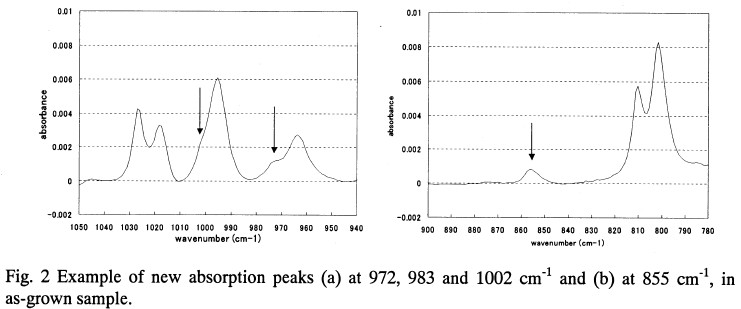
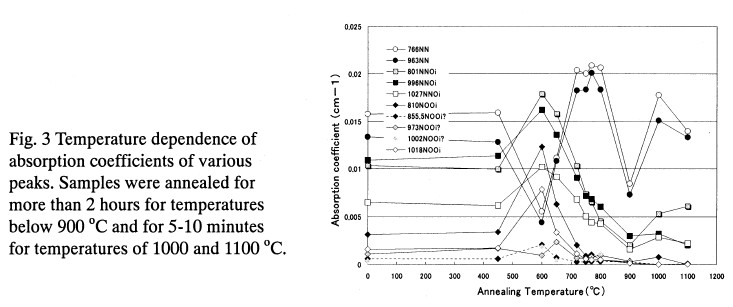
We examined LVM IR absorption of STD. In 2003, quasi equilibrium among (NN), (NN)O and O(NN)O in annealing was reported [9]. We examined the same annealed samples and found candidates at 714, 736, 841, 855, 862, 941, 945, 973, 1002, 1008, 1065 cm-1 in 2004 as shown in Fig. [10]. In 2005, we reported 3 of them at 855, 973 and 1002 cm-1 and assigned 973 and 1002 cm-1 as O(NO)O from the O(NN)O like thermal behavior [11, 12, 13]. We asked the theorists to calculate LVM. In 2007, they reported the results on (NO), (NO)O and (ONO), and assigned the observed 973 and 1002 cm-1 as (NO)O and 855 cm-1 as (ONO) [14].
The problem arose, 973 and 1002 cm-1 absorption behavior suggests 2 O accompanying with (NO) and 855 cm-1 accompanies at least 1 O. (ONO) must be largest at 800 oC, conflicting with the observed thermal behavior.
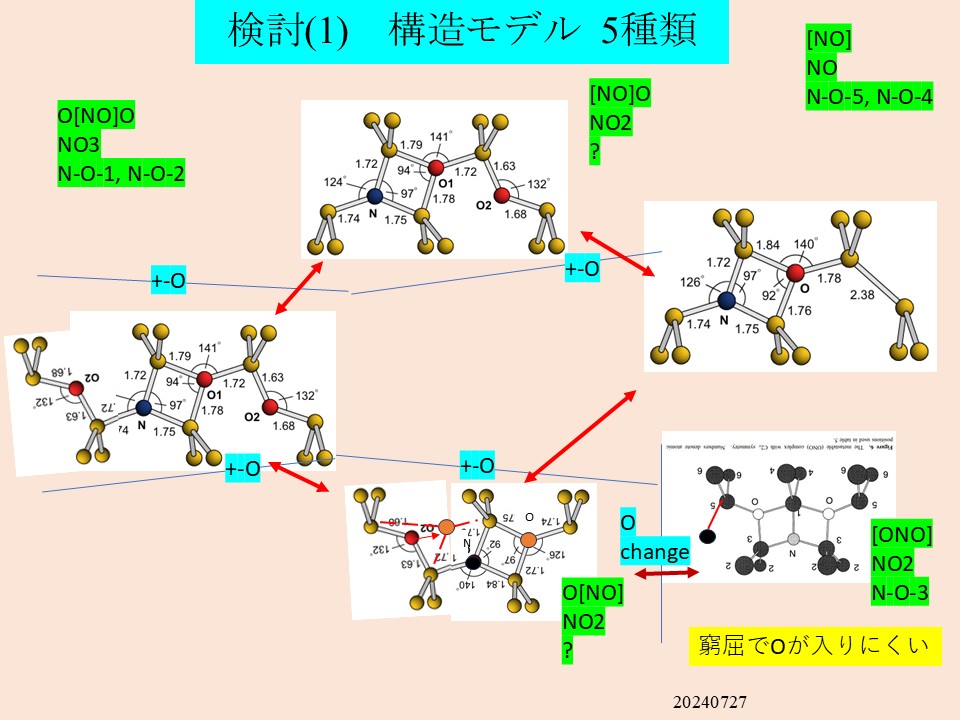
We composed 5 models for STD; (NO), (NO)O, O(NO), O(NO)O and (ONO). We took care (1) N-O-3 at 240 cm-1 and N-O-4, 5 at 242 and 250 cm-1 remain after annealing at 800 oC, suggesting no O accompanies. (2) Thermal behavior of N-O-3 deflects around 600 oC [2, 3]. We interpreted it due that there are low-T type and high-T type. For (2), we examined absorption around 855 cm-1. Previously observed 840 and 862 cm-1 absorption (Fig.) shows peak at 800 oC. Therefore, we concluded that 855 and 1065cm-1 absorption comes from O(NO) and 840 and 863 cm-1 from (ONO).
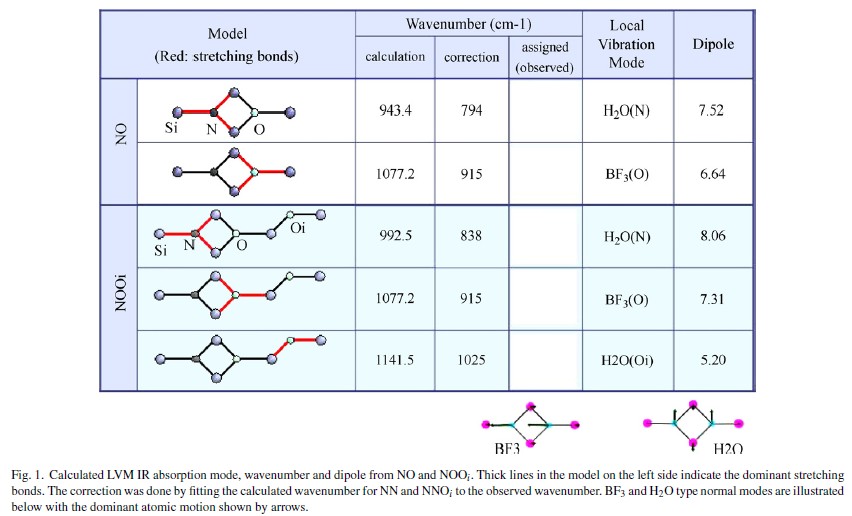
For (1), We examined high-T absorption at 714 cm-1. In 2018, we reported it from irradiated and annealed O-rich NFZ samples and named it 800 oC group [15]. It must be (NO) originated. (NO)O absorption is left. It may locate at 10-20 cm-1 higher frequency. 739cm-1 absorption is the candidate. Like other absorption it overlaps the strong phonon bands, making analysis difficult. Table summarizes the identification of STD LVM IR absorption bands and correspondence with electron transition. There are low-F H2O type and high-F BF3 type LVM for all STDs. More absorption will be assigned.
[1] Zorin, Sov. Phys. Semicond. 2, 111 (1968). [2] Suezawa,JJAP, 25(10A), L859 (1986), [3] Suezawa,JJAP, 27(1R), 62 (1988). [4] Ewels, Phys. Rev. Lett. 77, 865 (1996). [5] Gali, J. Phys. Condens. Matt. 9, 7711 (1996). [6] Voronkov, J. Appl. Phys. 89, 4289 (2001). [7] Porrini, ECS Proc. 2003-03, 75 (2003). [8] Jones, Phys. Rev. Lett. 72, 1882 (1994). [9] Tanahashi, JJAP, 42 Pt. 2, L223 (2003). [10] Inoue, unpublished (2004). [11] Inoue, Solid State Phenomena, 108-109 (2005) 609. [12] Inoue, Physica B, 376, 101 (2006). [13] Inoue, Materials Science and Engineering, B134, 202 (2006). [14] Fujita, Physica B, 401-402,159 (2007). [15] Inoue, JAP, 123, 185701 (2018).
(4)各構造、LVM赤外吸収と、熱処理による反応の模式図
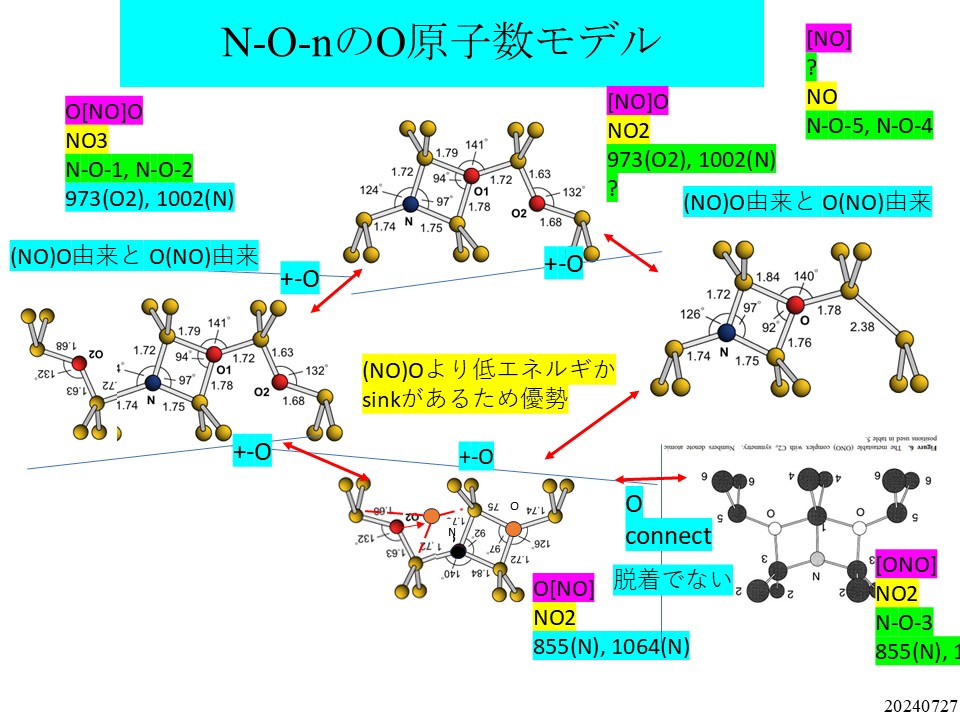 (3) N-O-3の低温型と高温型
我々は、N−O−3の温度依存性の起源は低温のO(NO)構造と高温の(ONO)構造に起因すると考えました。
そうすると
855, 1064�p-1吸収は低温型のO(NO)であることが分かります。
NOn複合体の同定、
Oの付かない高温型は(NN)と同様に800℃で最大と思われるので、無窒素試料を参照試料として差吸収スペクトルを測定、水色
(4)温度依存性
残るは973、1002�p-1が(NO)OかO(NO)Oか、残る方の吸収は何か
(3) 高温型吸収の探索
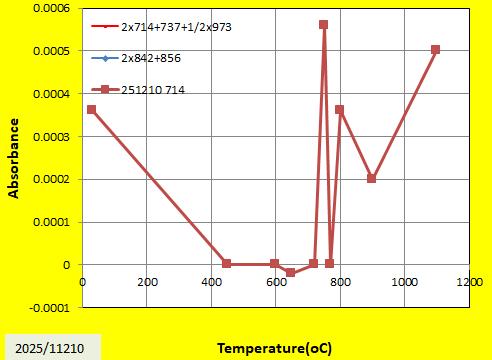
(ii) 高温型(NO)の吸収、714�p-1の同定
714�p-1吸収はFZ結晶の熱処理で800℃に強く見られる。
また理論計算では(NO)のLVMが722,801,1001�p-1と予想されている。
714、862�p-1吸収の温度依存性は800℃と750℃で大きく、770℃で小さいという共通性を持っている。これはNNが800℃を頂点にその周りで大きくなっているのと対照的である。
従ってOの着脱反応の温度依存性が異なると考えられる。
これはO(NO)と(ONO)の間にNOも関与した複雑な反応があるのではないかと考えられ、今後の課題である。
900-1100℃の挙動もNNと異なっている。
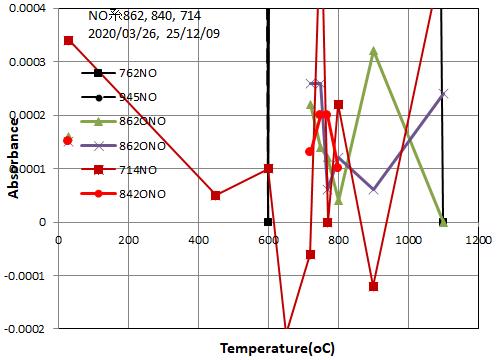
(3) 高温型吸収の探索
(i) 高温型(ONO)の吸収、840、862�p-1の発見
高温型は(NN)と同様に800℃で最大と思われるので、無窒素試料を参照試料として差吸収スペクトルを測定、橙色
714, 720, 736, 801, 820, 840、862, 940, 945�p-1などに800℃とas-grownで高温型の候補と見られる弱い吸収5
NNの766�p-1と963�p-1吸収は低波数側のすそ野が高くなっている。
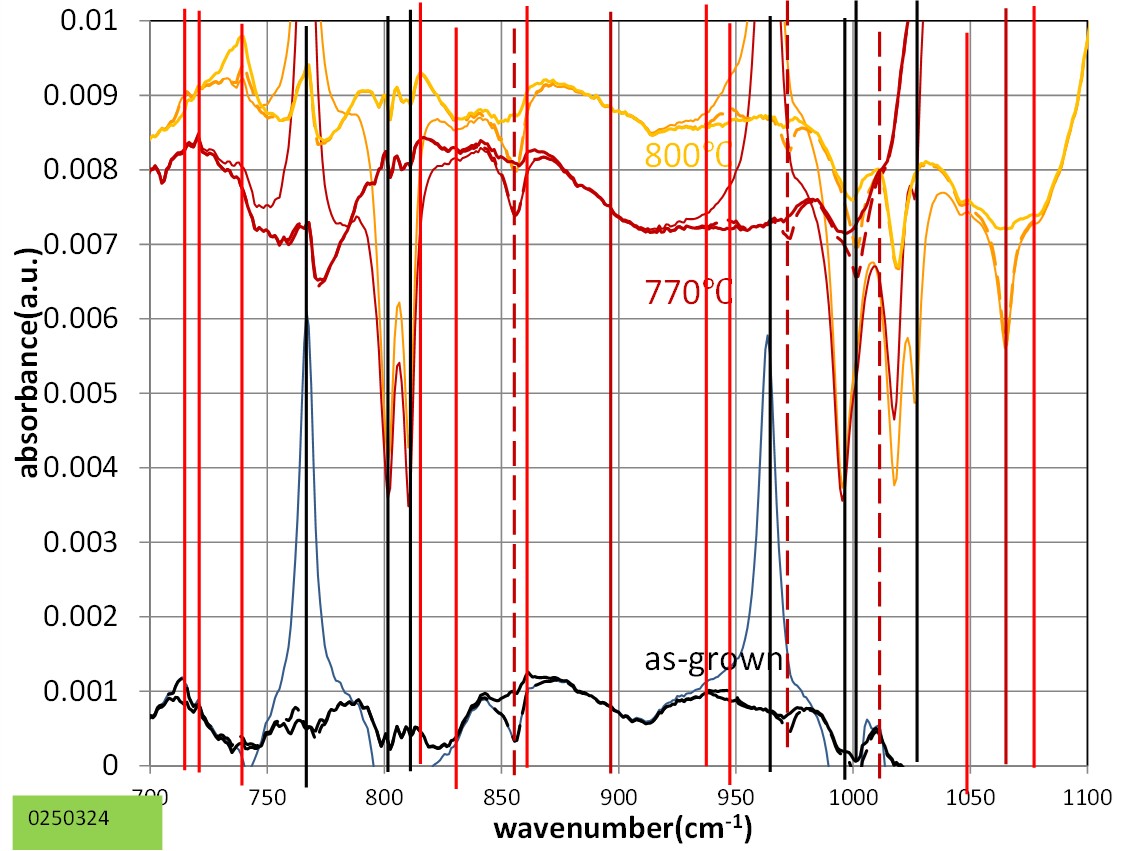
855�p-1吸収の周辺は妨害吸収がなく調べやすい
また低温側のO(NO)吸収だとすると、構造の似た高温型の(ONO)の吸収が20�p-1程度以内の周辺にあると期待される。
855cm-1が低温側にあるのに対して842、862、873�p-1吸収が高温側で現れる
従って、これが(ONO)の吸収である可能性が高い。
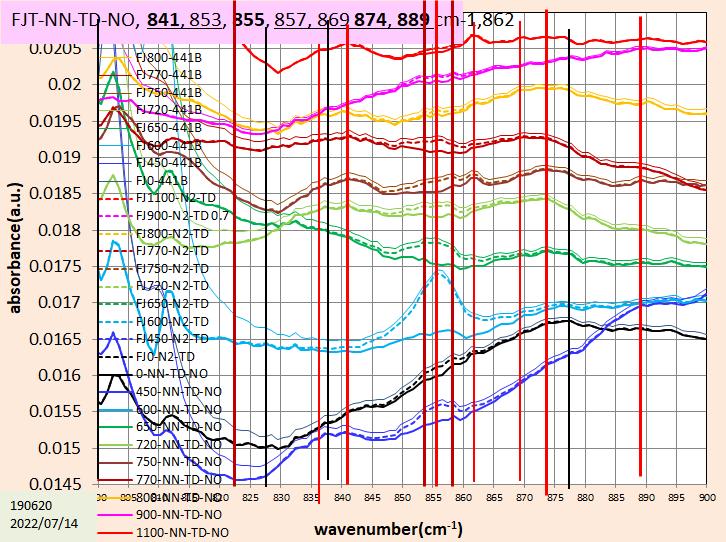
計算と測定
| N |
|
| O |
|
|
|
| H2O | BF3 | Oad | H2O | BF3 |
| Oad |
(NO) | 794 | | | 714 | 915 | | |
| 801 | 1001 | | 722 | | | |
(NO)O | 838 | | | 737 | 915 | | 1025 |
| 812 | 1022 | | 794 | | | 670,977 |
O(NO)O | | 1002 | | | | | 973 |
| 812 | 1022 | | 794 | | | 670,977 |
| | | | | | | |
O(NO) | 855 | 1064 | | | | | |
| 856 | 1084 | | 751 | | | 658,970 |
(ONO) | 862,840 | | | | | | 945? |
| 856 | 1084 | | 751 | | | 658,970 |
| | | | | | | |
High sensitivity infrared absorption spectroscopy and infrared defect dynamics of silicon crystal/
2-nd generation (26) LVM IR absorption of shallow thermal donor
シリコン結晶の高感度赤外吸収と赤外欠陥動力学/第二世代 (26)シャロ-サーマルドナーの赤外吸収
Radiation Research Center, Osaka Metropolitan Univ.1 ○N. Inoue1, S. Kawamata1 and S. Okuda1
大阪公立大学放射線研究センター1, ○井上直久1,川又修一1, 奥田修一1
応物学会2025年春14p-K306-2
(2) 低温型吸収の探索
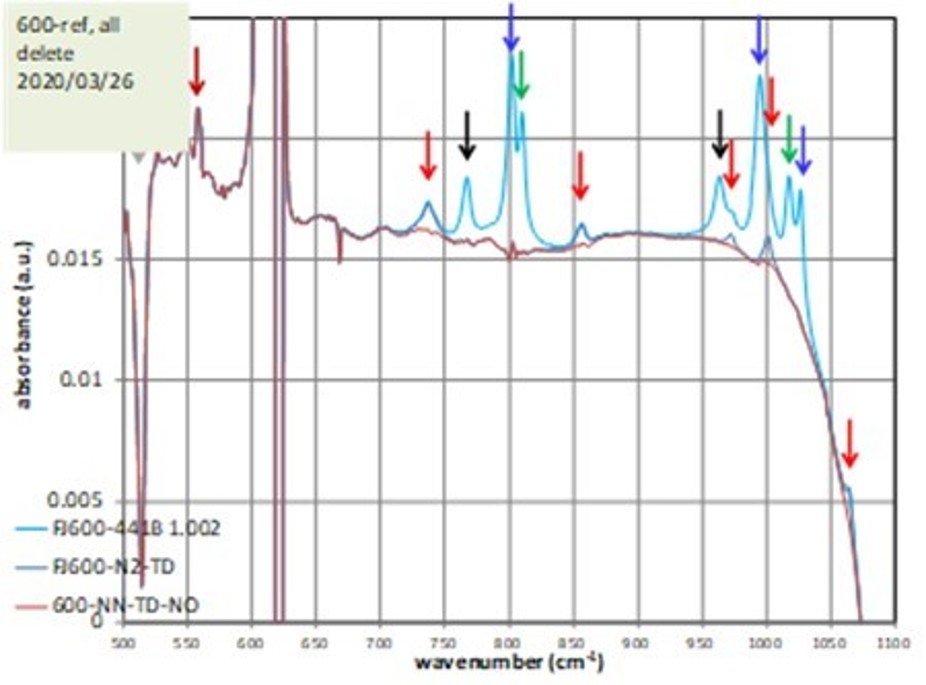
低温型は(NN)径と同様に600℃で最大と思われるので、無窒素試料を参照試料として差吸収スペクトルを測定、水色
(NN)系吸収の近くに現れると考えられるので、消去する茶色、黒矢印の(NN)径の他に赤矢印で示す
736,855,973、1002、1064�p-1吸収が見られる。
736�p-1を除いては、O(NO)O, O(NO)と見られる。736�p-1は他に比べて巨大で幅が広いため疑問。551cm−1はNi。
FZ結晶の照射結晶では、762、951cm−1は600℃型、但しSTD検討資料では弱い
 973, 1002, 855, 1065cm-1は801cm-1の(NN)Oよりも810, 1018cm-1のO(NN)Oに近い
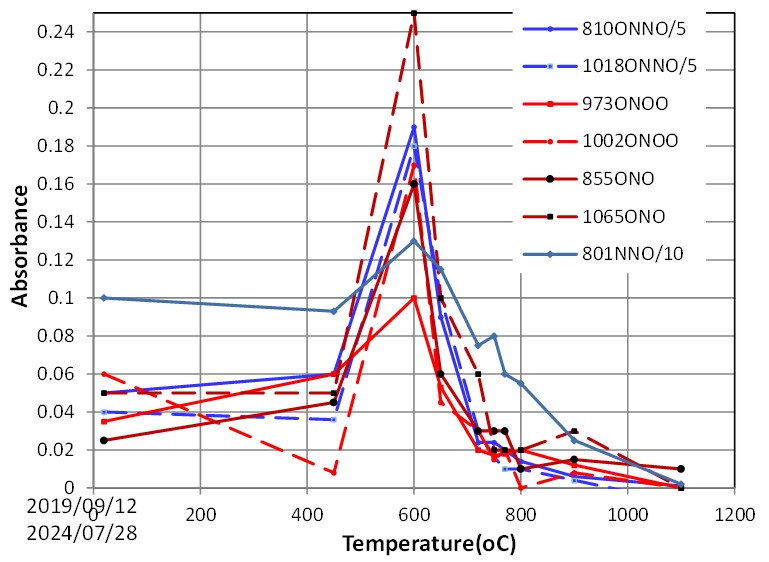

N-O-3, NO2, ONOに高温型と低温型
高温で(ONO)、低温でO(NO)
855、1065�p-1吸収は低温型のO(NO)、862�p-1吸収が高温型の(ONO)
3つまで発見・同定
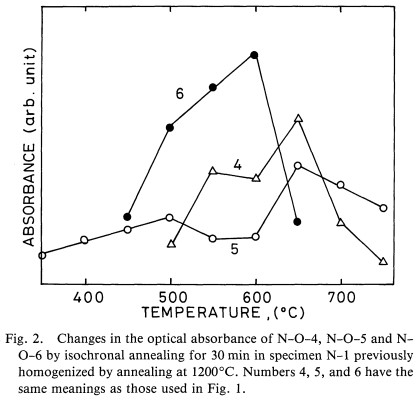
N-O-3の強度の温度依存性が800℃で直線的に折れ曲がっていることが1986年に報告されています。
この結果から、N-O-3は高温と低温で、遠赤外電子遷移吸収では区別のつかない2つの状態があると考えました。
(ONO)ダブルリングとO(NOとは原子の配置まで同じです。
OのついたO(NO)が低温型、ダブルリングが高温型と考えられます。
855、105�p-1吸収は低温型のO(NO)と考えることができます。
855�p-1の吸収には高波数側と低波数側に吸収があり、800℃以上で強くなります。ます。
これが(ONO)と考えられます。
862�p-1は2004年にすでに候補として採り上げています。
構造モデル
NNに(NN)O. O(NN)Oがあるのに倣って、(NO)にも(NO)O, O(NO), O(NO)Oと合わせて4種類あると考えた
また(ONO)を採用した。(ONO)O, O(ONO)があるかどうかは分からないとした
2009
2007 酸素原子数、N-O-5をNO、N-O-3をNO2と推定
Thermal stability and vibrational spectroscopy of N-O shallow donor centers in silicon
Hans Christian Alt, and Hans Edwin Wagner
Journal of Applied Physics 106, 103511 (2009); doi: 10.1063/1.3253759
STDの濃度依存性を電子遷移吸収により調べ、質量作用の法則を用いて、各STD]に含まれるO原子数を推定しました。
エネルギの最も深いN-O-5をNO、最も量の多いN-O-3をNO2と推定
N-O related shallow donors in silicon: Stoichiometry investigations
H. Ch. Alt, H. E. Wagner, W. v. Ammon, F. Bittersberger, A. Huber, and L. Koester,
Appl. Phys. Lett. 91, 152102 (2007); https://doi.org/10.1063/1.2795801
Chemical composition of nitrogen-oxygen shallow donor complexes in silicon
H.Ch. Alta, , H.E. Wagnera, W.v. Ammonb, F. Bittersbergerb, A. Huberb, L. Koesterb
Physica B 401-402 (2007) 130-133
2007理論研究が協力、同定の確認、855�p-1をONOと同定、1065�p-1も
しかし低温型なのでO(NO)
4つの吸収、2つの構造の同定
我々の依頼に応じてJonesのグループは計算を行い、972,1002�p-1吸収を(NO)O,855�p-1吸収を(ONO)起源と推定しました。またONOには1065�p-1吸収があることを示しました。
O(NO)O構造や(ONO)O構造の計算はしていませんでした。
972,1002�p-1吸収はO(NO)Oが正しいと思います。
855�p-1吸収の温度依存性は(NN)ではなく(NN)OかO(NN)Oに近いです。
1065�p-1吸収は2004年に候補としていたので、同定できました。温度依存性は(NN)ではなく(NN)OかO(NN)Oに近いです。
First-principles study on the local vibrational modes of nitrogen-oxygen defects in silicon
N. Fujita, R. Jones, S. O¨ berg, P.R. Briddon
Physica B 401-402 (2007) 159-162
2005, 2006局在振動赤外吸収の同定
973,1002cm−1をO(NO)O
855�p-1は不明
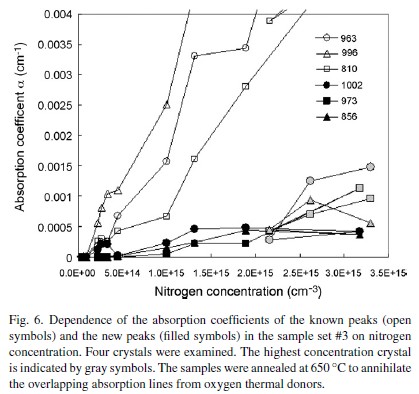
2005年と2006年に我々は、972,1002,855cm−1吸収を報告しました。前2つはNNの963�p-1吸収や、NNOの996�p-1吸収に近い波数で、」855�p-1吸収は既存のNN系吸収から離れています。972、1002�p-1吸収は温度依存性がO(NN)Oに近いことからO(NO)Oと推定しました。855cm−1の構造は不明でした。
他にも多くの候補が見つかりましたが、報告しませんでした。
Infrared absorption peaks in nitrogen doped CZ silicon
N. Inoue, M. Nakatsu, H. Ono, and Y. Inoue
Materials Science and Engineering: B Volume 134, Issues 2-3, 15 October 2006, Pages 202-206)
指針
微弱なので、高感度測定
NN正方形と構造が似ているので、NN系吸収の近くに現れる
(NN)系と同様なO付着をしていると思われるので、NO吸収のやや高波数側で600℃を最大とする温度依存性の可能性
973、1002、855�p-1はいずれもNNO, NNOOと同じ低温型で正方形にOが付着した構造と見られます。特にNNOOに近い急峻な低下なのでOが2個付いている可能性が高い。
855�p-1吸収も低温O付着型と見られます。
Local vibration modes of shallow thermal donors in nitrogen-doped CZ silicon crystals
N. Inoue, M. Nakatsu and H. Ono, Physica B 376-377 (2006) 101-104
後に
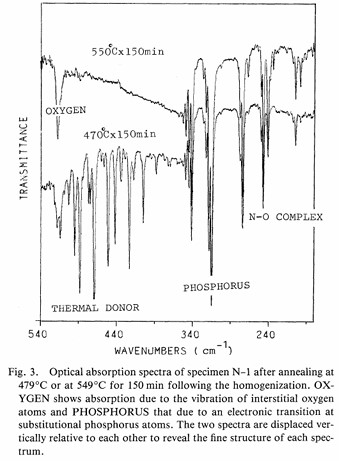
250 N-O-5は(NO)で高温型
240 N-O-3はO(NO)で低温型
と分かるのでこの温度依存性はほぼ妥当です。
N-O-3は高温型(ONO)があるが、この測定では分からない
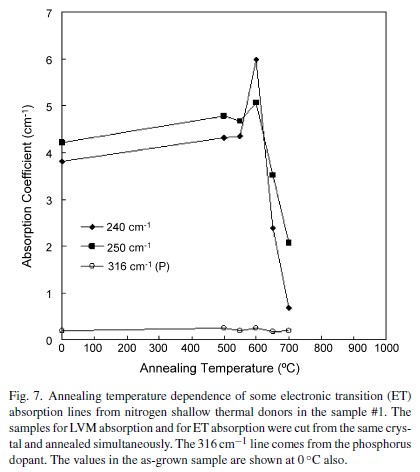
後に
242 N-O-4, 250 N-O-5はいずれも(NO)で高温型
234 N-O-1, 238 N-O-2は (NO)O系で低温型、240 N-O-3も低温型
と分かるので電子遷移が右図のように分かれるのは妥当
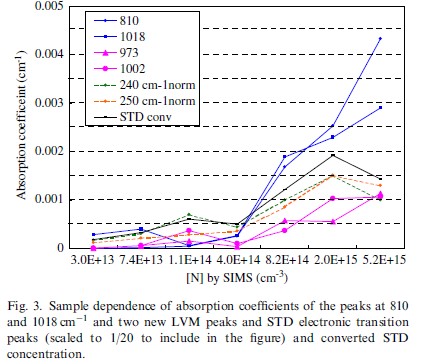
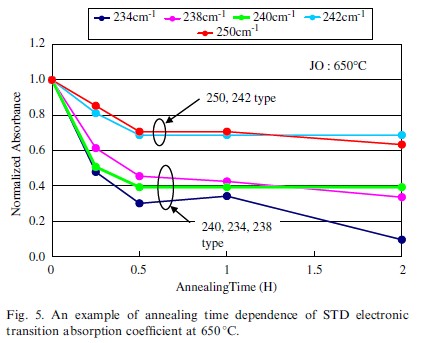
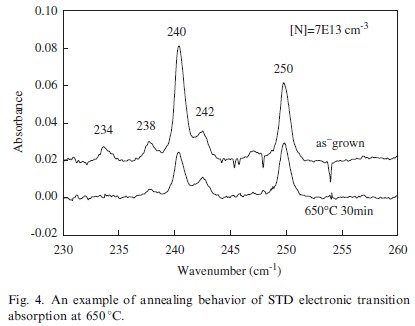
2004年
STDの局在振動赤外吸収の候補の発見
波数714, 736, 841, 855, 862, 941, 945, 973, 1002, 1008, 1065 cm-1
973cm-1吸収はNNの966�p-1吸収の裾に、1002c�p-1吸収はNNOの996�p-1吸収の裾に重なっています。855�p-1吸収は孤立。
この3つの吸収は大きくて確実です。
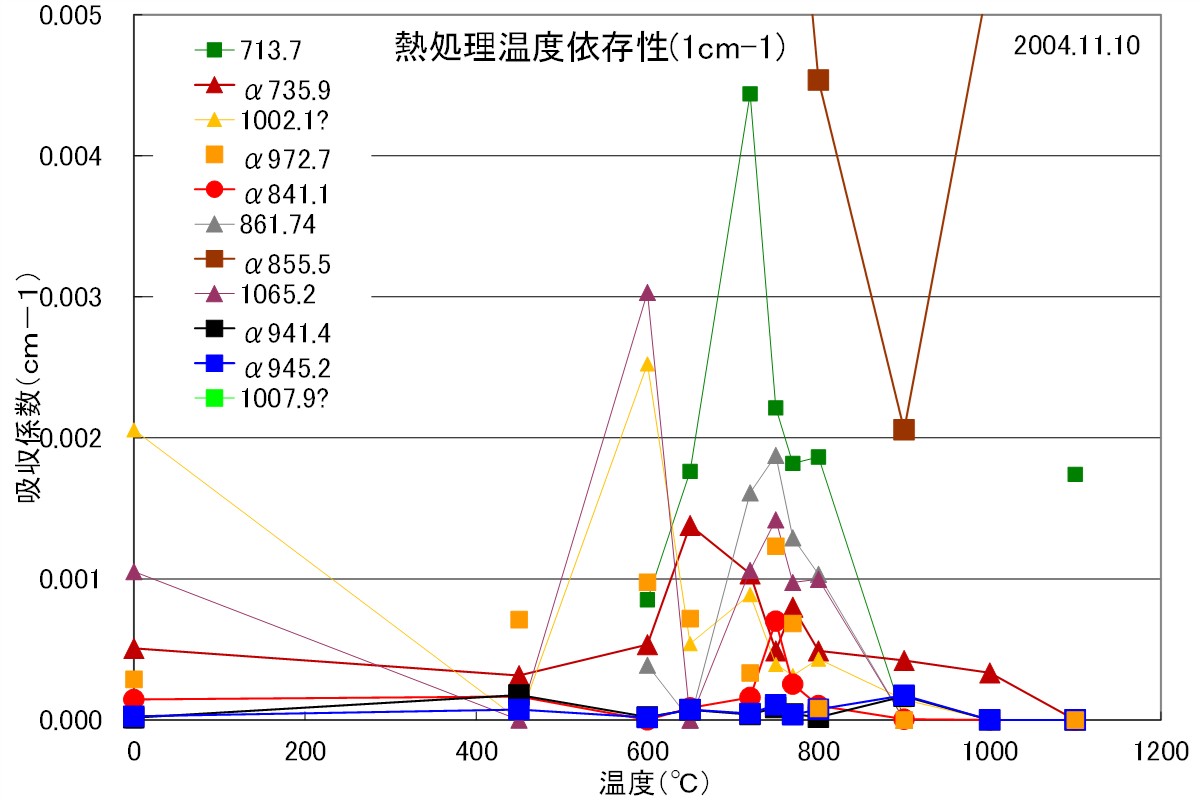 応物学会2025年春予稿 14p-K306-2掲載
先行研究
2001N濃度測定への提案(Voronkocv)
低窒素濃度ではNの大部分が単体でshallow thermal donorになると主張
600℃熱処理後のN-O-5 (240cm-1) + N-O-3 (249cm-1)の和で窒素濃度が測れるとした。
その後の我々の研究によれば、N-O-5は(NO)、N-O-3はO(NO)であり、シャローサーマルドナーの一部に過ぎない。またそれを何倍かしても全STDとはならない。
それよりも、すでに単量体ではNiがSTDよりも多いことが分かっておりこれらの主張は間違っており、STDにより窒素の嘘を測ることはできない。
Shallow thermal donors in nitrogen-doped silicon
V. V. Voronkov, M. Porrini, P. Collareta, M. G. Pretto, and R. Scala, R. Falster
G. I. Voronkova, A. V. Batunina, V. N. Golovina, L. V. Arapkina, A. S. Guliaeva,
and M. G. Milvidski
J. Appl. Phys 89(8), 4289 (2001) DOI: 10.1063/1.1356436
1996 Si-N-Si-O 正方形モデル
NO構造モデル、ONOモデル
1996年に、1994年に窒素の主要な構造がSi-N-Si-N正方形であることを明らかにしていたエクゼター大学のJonesのグループがシャローサーマルドナーはSi-N-Si-O正方形であるとするモデルを発表しました。またそれが背中合わせにくっついているとするONO構造も提案しました。
Shallow Thermal Donor Defects in Silicon
C. P. Ewels and R. Jones, S. ?berg, J. Miro and P. De?k
Phys. Rev. Lett. 77(5) 865 (1996).
Theoretical studies on nitrogen-oxygen complexes in silicon
Adam Gali, Jozsef Miro, Peter Deak´, Chris P Ewels and Robert Jones
J. Phys.: Condens. Matter, 8, 7711 (1996).
1986, 1988電子遷移による極低温遠赤外吸収
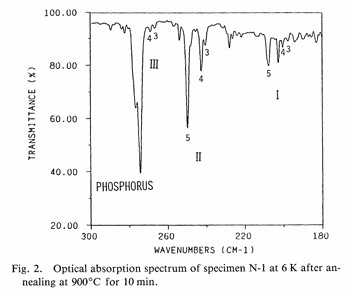
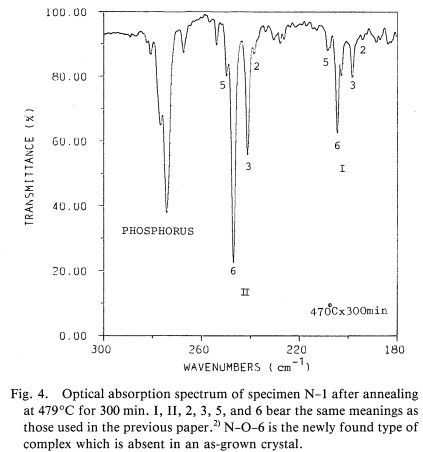
東北大学の末沢らは、He温度での遠赤外吸収により、N-O-1からN-O-6と呼ぶ吸収を見つけ、準位を決定しました。
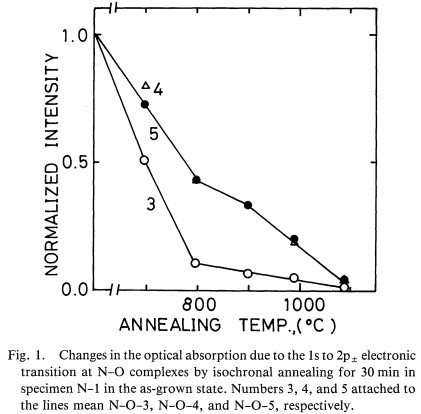
また1100℃の高温前熱処理により消去してから、低温熱処理による挙動を調べました。
N-O-4,5は1000℃までの高温にも残存し、N-O-3の温度依存性には800℃で折れ曲がりがあります。
Nitrogen-Oxygen Complexes as Shallow Donors in Silicon Crystals
Masashi Suezawa1, Koji Sumino1, Hirofumi Harada2 and Takao Abe2
Japanese Journal of Applied Physics, Volume 25, Number 10A, L859 (1986).
https://iopscience.iop.org/article/10.1143/JJAP.25.L859
The Nature of Nitrogen-Oxygen Complexes in Silicon
Masashi Suezawa1, Koji Sumino1, Hirofumi Harada2 and Takao Abe2
Japanese Journal of Applied Physics, Volume 27, Number 1R
https://iopscience.iop.org/article/10.1143/JJAP.27.62
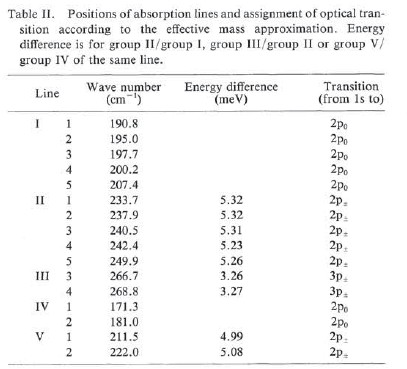
| 1s-2p |
| N-O-1 | 233.8 |
| N-O-2 | 237.8 |
| N-O-3 | 240.4 |
| N-O-4 | 242.5 |
| N-O-5 | 249.8 |
| N-O-6 | 247.0 |
後に
242 N-O-4, 250 N-O-5はいずれも(NO)で高温型
240 N-O-3, O(NO)は低温型
と分かるので、図の温度依存性は妥当です。
シャローサーマルドナーの発見